This page provides a summary of each session as well as links and resources at the bottom of the page which were referred to and discussed during the Small-Scale Touring Workshop and Forum which took place on Thursday 20th November 2025, in Glasgow, co-run by Company of Wolves and FST, with support from SUPERFAN.
The workshop was a space for artists and companies who wanted to learn how to tour performances to small and medium-scale venues in Scotland. The forum was for professionals already involved in touring small scale work and provided a place to share knowledge, resources and best practice and ask questions of peers.
Workshop Session Overview
Why Tour? Introducing Yourself and Your Work to Venues
- Be clear on why you want to tour. This will guide your decisions and communication.
- Touring is time consuming and expensive. Clarity helps with long-term planning.
Choosing Where to Tour
- Medium-sized venues in medium-sized towns (e.g. outskirts of Glasgow, Perth, Stirling) can be harder to book as they often lack resources and established networks.
- Village halls are generally more open and easier to work with – consider making work that fits village halls first, then scale up rather than scaling down.
- When working in village halls: Be mindful of sightlines and audience capacity and consider creative seating solutions (beanbags, benches), though local rules may vary.
Audience Expectations
- You may perform to very small audiences. The key: make it clear you’re genuinely happy they are there. It removes pressure and embarrassment for the audience.
Building Relationships
- Strong relationships with local venues and programmers are crucial.
- The Touring Network programmes events and provides space to meet village hall programmers.
- FST Emporium will return next year – another good opportunity to meet programmers.
Communicating With Venues
- Keep emails short, human, and clear.
- Include a link to the work (or previous work).
- Offer the option of a call.
- Avoid industry jargon. Your description of yourself really matters.
- An elevator-pitch template for contacting programmers would be useful.
Insurance
- ‘Touring insurance’ is generally not worth the cost (approx. £2k).
Better option: Employers’ Liability Insurance.
Timelines, Funding & Budgets
Funding Applications
- Write humanely and from the heart. Panels vary in expertise; minimise jargon.
- Communicate passion and clarity.
- Read the terms & conditions carefully.
Creative Scotland Touring Fund
Read the current touring fund guidelines before you apply as Creative Scotland makes changes/updates to them which may affect how you write your application and structure your tour.
- You can request the full amount needed to produce and tour your work. Creative Scotland aims to fund the full amount requested and will only reduce your request if your budget includes ineligible costs.
- Box office spilt is on an 80/20 basis in the programmers’ favour.
The touring fund is for: - Brand new productions that have yet to be made and toured.
- Works-in-progress that have completed research and development and need support to finish before touring.
- Tour ready productions that have premiered or had a short run to generate programming interest.
- Restaging/remounts of successful productions that can secure further touring opportunities
- You don’t need to have confirmed arrangements with venues before applying, just a strong rationale for the venues/promoters you have chosen.
- The tour needs to be to a minimum of four locations. Beyond this, there is no set number of tour locations and applicants are advised to consider being ambitious in the number of venues and/or host locations to increase the reach of the tour.
- When deciding your tour format and number of locations, you should consider financially and environmentally efficient ways to tour, explain why you’ve chosen your audiences, specific regions and venues/host locations and how your work fits their programming.
Timeline
- Would not recommend more than 3 venues per week.
- Touring takes a long time to organise: 8-9 months from when the application for the Touring Fund deadline is standard. Even up to 18 months is realistic.
- Make the show as self-sufficient as possible (you should be able to set it up yourselves).
Budgets
- Include a contingency (‘pillow’) of 5–10%.
- Touring is expensive:
- £75/night per person for accommodation is common.
- Sharing rooms may be necessary in expensive remote areas (e.g. Isle of Skye).
- Producers, production managers, and touring techs are currently hard to source – use FST’s database for this.
Contracts, Insurance & Responsibilities
- Once you have the funding and the tour mapped out, ensure contracts and schedules are in place.
- The contracting organisation is responsible for the people hired – make sure they have the tools and information they need.
- Employers’ Liability Insurance is essential.
- Contracts vary – Most touring workers are freelance.
- Actors may have employee rights:
- Holiday pay
- Pension contributions (required if employed 3+ months)
- Access riders/forms
- Schedules may need amending
Managing a Team
- Touring is tiring and stressful; personal issues can surface within small teams.
- Company managers or producers can act as support mechanisms.
- Have policies and administrative plans in place before hiring.
- Non-admin check-ins are valuable for nipping issues in the bud.
- Lung Ha’s Access Toolkit is widely applicable.
- There is no requirement to work 12-hour days.
- Factor in the physical toll of travel days.
- Keep cast and crew wellbeing at the centre of planning.
Marketing & Outreach
- Marketing is not just social media – local knowledge matters.
- Consider bringing someone on board who:
- Understands the region you’re touring to
- Has local connections
- Knows how to reach the target audience
- Workshop offerings can add energy and draw interest.
- Many venues do not reliably put up posters – another reason relationships matter.
- Try to learn about the village/town you’re going to.
- Identify a ‘champion’ in each community who can advocate for your work.
Forum Session
Introduction
The Small Scale Touring Forum was held on 20th November 2025, run by Company of Wolves and FST. Company of Wolves have run the Forum as an annual event for the previous 2 years; this is their first time running it in partnership with FST.
The event was attended by:
- representatives of theatre companies highly experienced in touring new work to small-to-mid-scale venues in Scotland
- individual touring artists
- representatives of Scottish touring networks
- specialists in emerging artist development
- artists, theatre-makers, directors, production managers, producers
- a staff member from Culture for Climate Scotland
The aims of the event are:
- To make space for those working in small-scale touring to connect with each other, share common challenges and opportunities, and build community
- To facilitate knowledge-sharing
- To lay the groundwork for more collaboration and resource-sharing in future
- To discuss practical actions that would benefit the touring sector in Scotland
Surveyed ahead of the event, and in the introductory chat, attendees named questions of particular interest for discussion, including:
- How do we amplify marginalised voices in the touring circuit?
- How do we promote and ensure wide access to diverse, cross-cultural performances?
- How do we connect more meaningfully with each local audience, when touring to so many locations?
- How do we better support work for younger and intergenerational audiences?
- How do we secure funding for smaller scale touring; what are the limitations of Touring Fund, and what other funding routes are possible?
- How do we meet the rising costs of production and touring?
- How do we work with non-arts programmers?
- How can digital tools reduce the difficulty/workload of tour-booking, create efficiencies, and make the marketplace more meritocratic?
- How can people newer to touring learn about the process of booking and producing a tour?
- How do we make touring shows involving less artistic compromise?
Session Overview
The first session involved introductions, where everyone shared who they were and their reason for attending. We were then split into three groups to discuss the following topics:
- Audience Engagement & Development – including:
- audience development and delivering participation activity on tour;increasing access for audiences;
- diversifying touring audiences
- Working with Venues – including:
- Venue relationships with touring companies;
- Resource-sharing from venues
- Sustaining and Sustainable Touring – including:
- Increased sustainability through resource-sharing and knowledge-sharing between touring companies
- Sustainability through self-care and wellbeing focus while touring
- Logistics and practicalities of touring effectively
- Environmental sustainability within touring
Audience Engagement & Development:
- Building an audience is particularly challenging when a company only appears in a community for a single night.
- Workshops can be a strong engagement tool – participants are very likely to attend the performance afterwards.
- Doing R&D residencies in these areas can help build relationships with local communities and develop work with them in mind.
- It’s a huge game-changer to have one designated person who is local and understands how to engage the community. For example, knowing which local shops could display posters for the show. Having someone with genuine local knowledge makes a big difference. It can be really valuable to identify a “champion” in each community who can advocate for your work.
Working with Venues
- Marketing often emerged as an issue: some Forum participants had experienced venues not putting up posters, making the effort to engage the community, or even communicate internally about the show.
- Each venue works differently – there may be value in creating a toolkit for both venues and small organisations outlining expectations and communication processes when organising a tour.
- Avoid blanket emails when approaching venues to put on your show; personal communication strengthens relationships.
- Venues face financial risks when programming new or unknown companies. A strong track record – showreels, reviews, and previous successful work – makes a venue more likely to take a chance.
- ‘Courting’ venues and communities is essential. Trust building is a long-term process but crucial for sustainable touring relationships.
- Venues want clarity in emails: what exactly are you asking for? Is it a joint venture? A straight hire? Something else?
- With more established venues, varied and complex technical infrastructures can pose challenges for touring companies.
Sustaining and Sustainable Touring:
- Look at the Climate Adaptation Toolkit – on Culture for Climate Scotland website. It includes case studies of climate adaptation actions taken by other Scottish cultural orgs.
- Look at the Culture for Climate Scotland Charter too – 4 headings: emissions, climate adaptation, climate justice, collaborating for wider support. There’s suggested actions under each area.
- Tourbook has the functionality to be able to work out the carbon emissions of your tour
- There’s concern about electric vans not being able to last long distances eg. for a Highlands tour. And potential lack of charging points in rural areas. But is there more infrastructure than we think there is? How to build an accurate picture of charging points available, and the reality of electric vehicle touring? Can people who’ve used electric vans to tour share their knowledge?
- Travel by public transport instead – have to account for the extra cost and time involved; and the potential wellbeing cost of longer travel times, possible added stress.
- Can we consider sourcing set and kit locally to each venue, rather than travelling with it? Using only what the venue has? But only if it wouldn’t artistically compromise the work.
- There are models for international touring, where the lead artist remotely trains people in other countries to recreate a certain performance work, rather than the lead artist travelling themselves to present it. Or only the lead artist travels, and they recruit other local artists to form the rest of the company; rather than the entire company travelling. Or could explore more licensing of shows to companies in other countries to perform; though feel at a minimum the director would have to travel and oversee it, to ensure the work remained intact
- A Scottish theatre company is doing an international collaboration ‘Slow Touring’ project, researching how to produce a carbon-neutral tour with all travel by train. This is only possible because the artists who are parents can bring their children on tour, so they don’t have to be away from them for extended periods. The approach takes significantly more time and money, and is only possible thanks to dedicated funding that allows them to explore how international collaborations can happen in a more environmentally sustainable way.
- The project is also exploring how to create a template for set design etc that can be recreated in different locations, rather than freighting the same set from country to country. Local manufacturers create the set in each location, so you’re also benefiting the local economy when visiting that place.
- Work with venues to better understand their local audience’s behaviour. E.g. in rural areas audiences will often car-share with their neighbours. There’s a village, for example that has a “community taxi” and community minivan that audience members book for the night and all go in together. How can we be helping to encourage shared travel options in areas that don’t have public transport options? We should be more aware of audience travel habits and track this data.
- Climate mitigation: touring companies are starting to build more time into tour schedules for travel to more remote locations – allow extra days in schedule in case weather disrupts travel. This unavoidably comes at a cost as it means fewer shows, fewer venues. Can we keep the option open to do more performances when we arrive, if delayed by weather?
- We are being asked to do a lot more work to improve our carbon footprints and track environmental data, but without extra time or funding for this work. This has a wellbeing impact, which threatens sustainability in another sense.
- Measures that foreground wellbeing might include:
- Budgeting for extra time needed to implement and track environmental sustainability measures
- Budgeting for additional costs of touring in a way that limits environmental impact
- Double casting / recruiting a bigger team than you might necessarily need, to reduce pressure of workloads and mitigate for any team member becoming ill or unavailable due to life stuff for part of the project
This all of course requires more money.
- Recommended for touring artists to have a better understanding of their personal “energy budget” on tour – what they have capacity to deliver in a single day – travel, get-in, performance, audience Q&A, running a workshop? This can help producers better understand what’s the maximum they should expect of their touring company on any given day, and arrange schedules accordingly.
- Staff at small companies constantly work over the hours we’re being paid for. How do we avoid self-exploitation? What about “accountability buddies”??
Headline takeaways:
- There is frustration among touring companies with the Touring Fund: it’s so competitive, meaning only a small % of work gets to tour and be seen more widely. It also limits companies’ ability to be enterprising and responsive to opportunities; for example if they have interest from 4-5 venues for a small tour, it’s not possible to fund it as it would be too many venues for Open Fund but not enough for Touring Fund. Equally it’s difficult to respond to interest from just a single venue, as not easily fundable.
- There’s also a suspicion that the Touring Fund means venues don’t always select work that they really want for their audiences, as they’re obliged to select from such a limited menu of shows. What if the balance of power was tipped back more towards venues- so they had more power to programme the work they really want?
- It would be amazing if venues could work together more, to programme collectively: that way more tours could be programmed in an order that made geographic sense, venues could market more collectively and collaboratively, it would help reduce the cost of touring. There could be more defined geographic routes for tours to take.
- Some venues might need to be more flexible – e.g. stop only programming shows on a Fri or Sat night, if that’s not the dates that work within a show’s schedule. To fulfil their environmental responsibility to help touring shows minimise back-and-forth travel. Venues have a responsibility to liaise with each other more and seek to collectively programme shows, so shows can tour in a more environmentally sustainable way.
- Venues are worried about competing for audiences, if a show visits multiple venues in the same region. Venues’ exclusion zones can therefore be quite restrictive. But touring artists’ experience is that doing multiple venues in the same region doesn’t split audiences. Many venues, especially in rural areas, often attract hyper-local audiences.
- One Scottish Theatre Company toured to multiple village halls in Strathspey, and found they each brought their own local audience – they sold well everywhere.
- Audience data can help address venues’ concerns about competing for audiences. Venues could be talking more openly to each other about their audiences.
- If venues were programming collectively, maybe they could help secure more affordable accommodation as well – e.g. block-book local accommodation to be used by multiple touring companies in succession? Can venues be doing more to help secure favourable local rates; as accommodation (especially in rural areas) can be SO expensive.
- For one Scottish theatre company’s tour of Strathspey, rather than using Touring Fund deals (where venues usually keep around 80% of box office revenue), they hired the halls directly. This let them schedule the tour in exactly the order and on the dates they wanted, with no gaps, giving them full control over the tour and allowing them to keep all ticket revenue. The trade-off was greater financial risk, since they paid all venue hire fees upfront.
- Some venues have resources such as free space they can offer to companies to rehearse / hold R&Ds in – their spaces are often sitting empty during the week, especially – companies don’t always know to ask them. There’s an opportunity to take advantage more of space that venues can offer.
- Creative Scotland could be doing more to share the massive amounts of data they collect, so the sector can learn from it. For instance, points of learning from end-of-project monitoring reports – there’s a wealth of knowledge here potentially – nothing is currently being done to collate and share this info?
- FST are working with Audience Agency to gather all the audience data from venues, and analyse, summarise and disseminate it – will be very useful. However bear in mind that many rural venues can’t gather audience data like established theatres can; so Audience Agency doesn’t produce meaningful data on rural areas; how to bridge this knowledge gap?
End of Session Chat – what could some practical actions be?:
- A shared, anonymised bank of example funding applications
- An event where previous recipients of Touring Fund share knowledge with forthcoming applicants – how to increase odds of application success
- Online knowledge-sharing platform for sustained communication in between events like this – so we can all learn from each others’ touring experiences. E.g. the Basecamp that is used collectively by the majority of touring companies in England
- Develop a shared resources page on the FST website to support sector learning and knowledge exchange
- A better system for accessing tour producers; a way of tracking who has capacity when. A producers “time bank” system ?
- More training routes for aspiring producers; making more people aware that it’s a good career route in theatre, you’ll always be in demand
- Incentivise companies to e.g. employ assistant producers for on-the-job learning – dedicated extra funding pot for this?
- Workshops on tour-booking for early career artists?
- FST to advocate for greater transparency from Creative Scotland regarding audience data
- Lobby Creative Scotland to share data and learning from monitoring reports. What about a monthly or quarterly digest?
- Introduce a “Personal Energy Budget for Touring” framework, for artists to use
- Venues to highlight when they have empty space that could be used
- Venues to more consistently make transparent their programming info- timescales, processes, criteria etc.
- Introduce best-practice guidelines for venues to follow when hosting touring companies
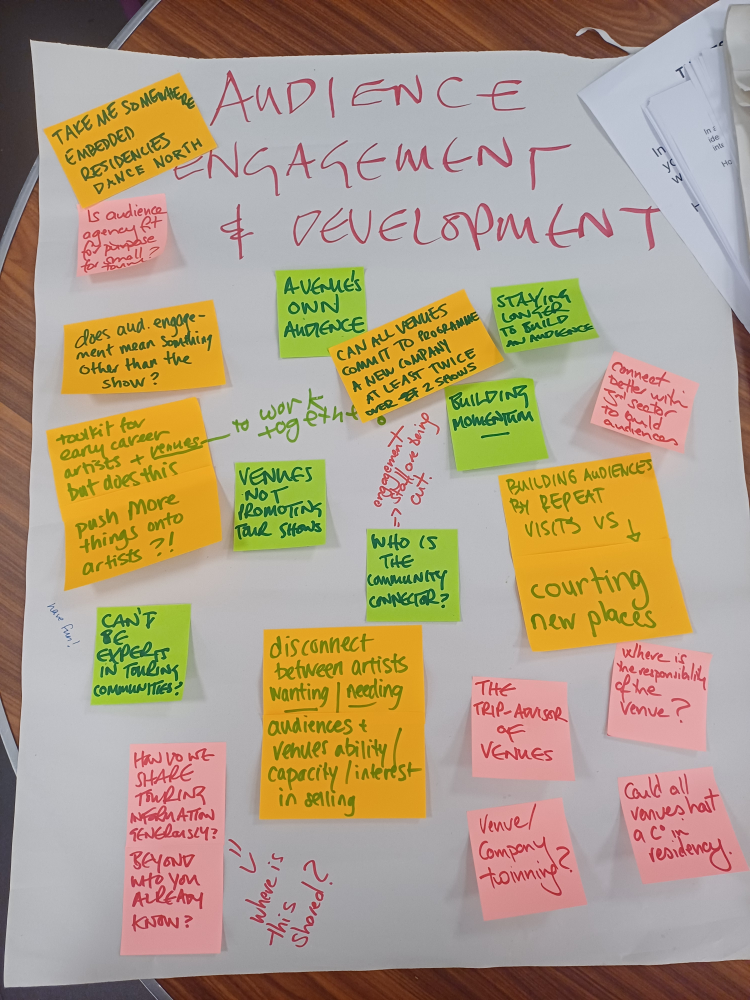
- Take Me Somewhere – Embedded Residencies Dance North
- Is the Audience Agency fit for purpose for small touring?
- A venue has it’s own audience
- Staying longer builds an audience
- Building momentum
- Connect better with third sector to build audiences
- Toolkit for early career artists and venues
- Can’t be experts in all touring communities
- Who is the community connector? Building audiences by repeat visits vs courting new places
- Disconnect between artists wanting/needing audiences and venues ability/capacity/interest in selling
- Can we get a the ‘trip advisor’ for venues?
- Where is the responsibility of the venue?
- How do we share touring info generously, beyond who you already now?
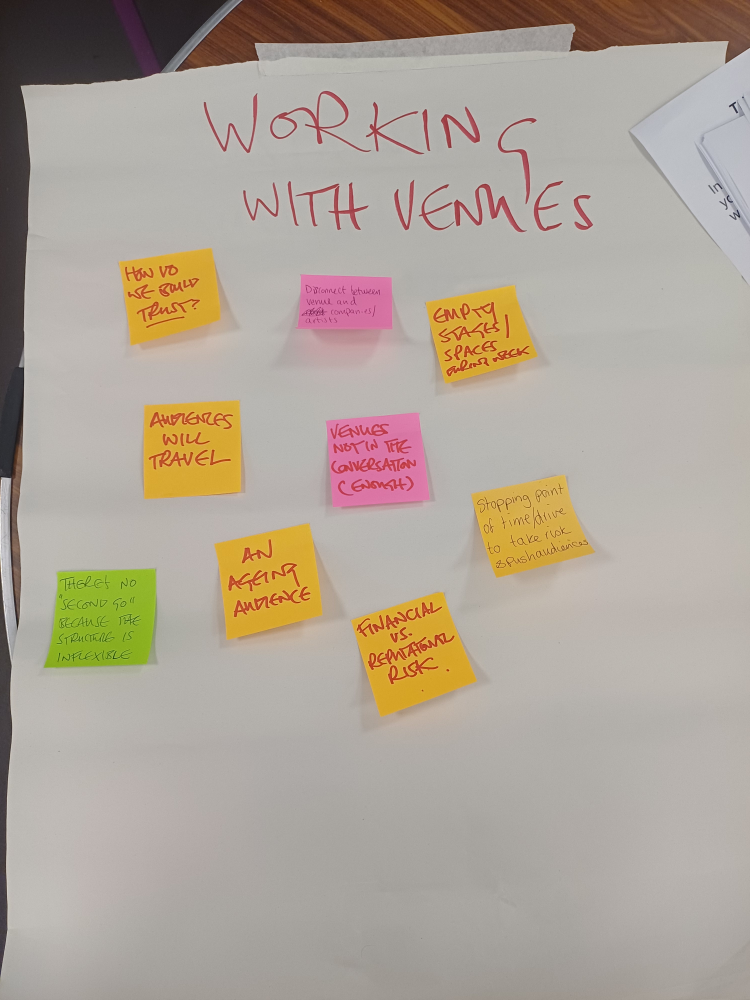
- How do we build trust?
- Audiences will travel!
- Venues have empty stages/spaces during the week
- A disconnect between venues and companies
- Financial Vs Reputational risk
- There’s no ‘second go’ because the structure is inflexible
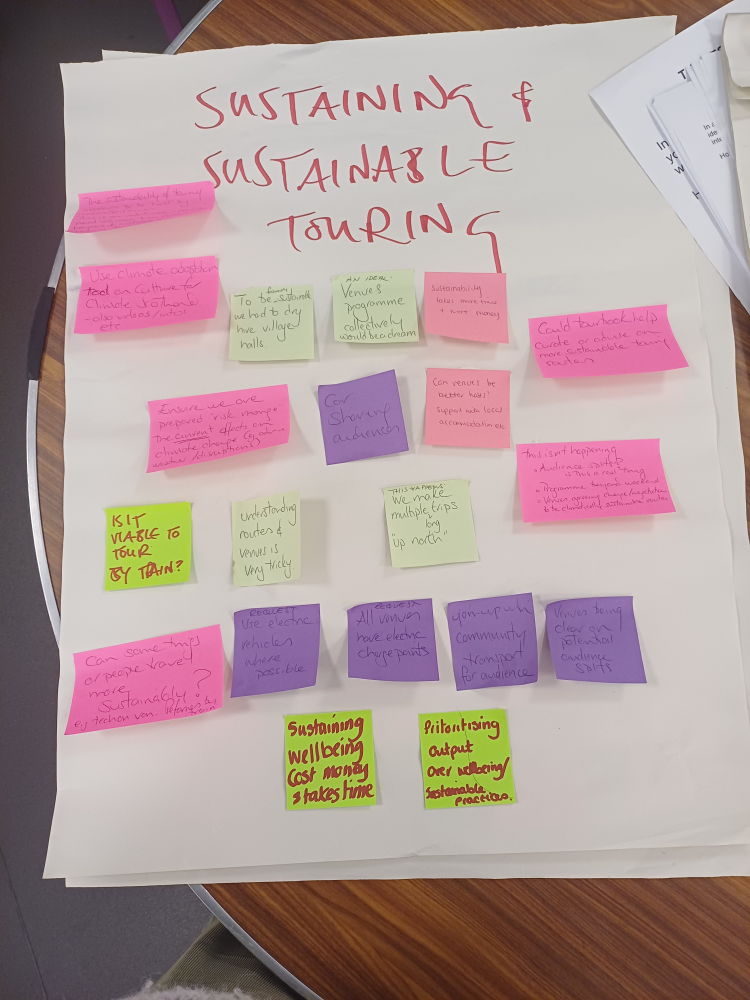
- An ideal: Venues programme collectively would be a dream
- Sustainability takes more time and more money
- Sustaining wellbeing costs money and takes time
- Is it viable to tour by train?
- Could Tourbook help curate or advise on more sustainable touring routes
- Can venues support with local accommodation?
- Car sharing/community transport for audiences?
- Programme beyond the weekend?
- Prioritising output over wellbeing/sustainable practices
- Understanding routes and venues can be very tricky
- Use electric vehicles where possible?
- The sustainability of touring appears to be held by makers/performers. This is an imbalance. Venues need to be more than receiving houses and have responsibility for making tours sustainable
- Use Climate Adaption tool on Culture for Climate Scotland